Today, I’m going to do something that may shock and surprise you.
I’m going to write about something almost never mentioned in history books — the American concentration camps in the Philippines.
I’ll try to do it by sharing short excerpts from my own novel. You might think I’m indulging in historical suffering, but that isn’t my intention. On the contrary, I hope you’ll see that it’s really about love, respect, and the struggle to do what is good in a world where reality rarely aligns with our moral ideals.
So why write about genocide — about the concentration camps in Cuba, in South Africa, and now in the Philippines? Because I believe we must understand our past in order to interpret our present. The same is true in historical fiction.
Nazism, and the era that came to shape Europe decades after Oscar’s letter to Heinrich, did not arise in a vacuum. The world was marked by its past — and by its present.
But now, let me take you to a few passages from a chapter in my novel.
Heinrich’s Night
Sixty‑four‑year‑old Heinrich was full of thoughts as he returned to his own safe apartment. The evening had been powerful, almost overwhelming, for everyone who had taken part. He spoke softly to his late wife, as if she could still hear him. “You would have been so proud of our dear Fanny tonight, Ida. She was so full of you…”
He placed another log on the fire, walked to the window, and let his gaze rest on the clear winter sky. The full moon hung like a pale eye over the landscape. As always on nights like this, he whispered the old prayer he had once learned from the Khoisan people in German South‑West Africa:
“When the moon dies each month, let the sin in me die with it. When the moon is reborn each month, let the good in me be reborn with it.”
Memory was a strange thing. Some moments he recalled with crystal clarity; others slipped away like sand through his fingers.
He was about to turn off the light when he noticed a letter lying half‑hidden beneath a pile of newspapers Hermann had brought from Berlin. He hadn’t seen it before. When had it arrived?
He lifted it up. The envelope was thick, stamped with an official seal. The postmark bore a name he hadn’t expected: The Philippines. Who on earth would write to him from there?
The date stamp was more than six months old. A familiar feeling of hopelessness and despair rose in him.
Had he received the letter and misplaced it? Or was there another explanation? His memory failed him more and more often. Books turned up in the shoe cupboard. Newspapers in the kitchen drawer. Whole days vanished into black holes.
He placed the letter on the bedside table, deciding to read it in the morning. But sleep wouldn’t come. At last he got up, lit the lamp, and opened the envelope. Electric light still fascinated him — that modern miracle that flared to life with a simple turn of a switch.
Heinrich opened it with trembling fingers.
The Letter from the Philippines – and Another Kind of Concentration Camp
Excerpt from Oscar’s letter in the novel:
“My own country — the United States — which once fought to free itself from the choking hand of imperialism, has now become an empire.”
After the Spanish‑American War, the United States took possession of Cuba, Puerto Rico, Guam, and the Philippines. What was meant to be liberation became a new occupation. Senator George Hoar had expressed what Oscar himself felt:
“This treaty will make us a vulgar, ordinary empire, ruling over inferior races and vassal states.”
Soon after Oscar’s arrival in Manila, war broke out between the United States and the Philippines. The Filipinos had expected independence. Instead, they received a new colonial master.
Oscar wrote:
“From being a doctor, I am now forced to take part in atrocities that violate everything human within me.”
The American Concentration Camps – A Forgotten History
What Oscar described was not propaganda. It was reality.
Between 1899 and 1902, the United States established a network of concentration camps in the Philippines — called reconcentration zones or protected zones in official documents. They were inspired by the Spanish camps in Cuba and later by the British camps in South Africa.
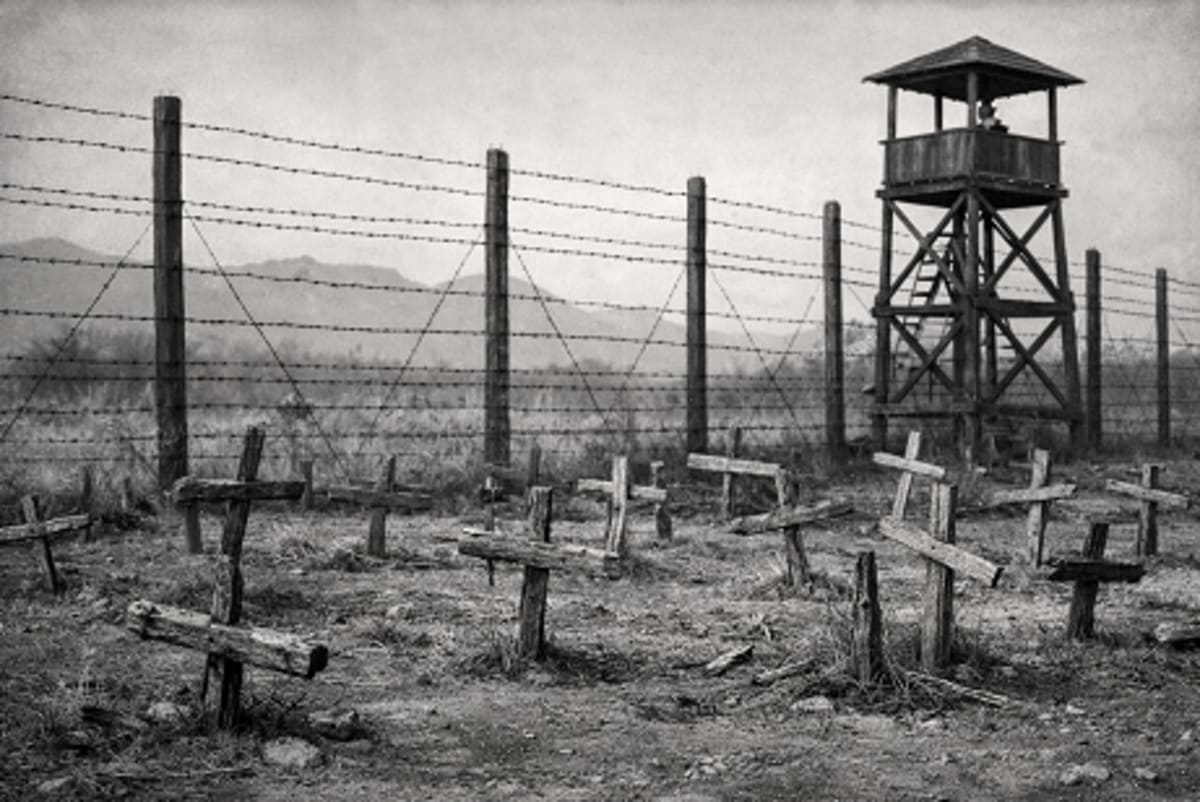
In these camps, entire villages were forcibly relocated. Food supplies were blocked or cut off completely. Epidemic diseases spread unchecked, and the internees received no medical care. Children died in such numbers that today we would almost certainly classify it as genocide. Civilians were confined behind high barbed‑wire fences, guarded by American soldiers armed with the new repeating rifles that could fire several rounds in succession.
Oscar wrote:
“We burn villages, Heinrich. I have seen children die in the arms of mothers who are not even allowed to bury them.”
He also described torture methods used by American soldiers — among them the notorious water cure, a form of water‑based torture later condemned by U.S. senators.
Officially, the United States claimed that few civilians had died. But Oscar had seen the statistics:
“One million people — mostly civilians — have been killed or have disappeared under our occupation.”
Modern historians estimate the death toll between 200,000 and 1,000,000, depending on method and source. Most died of hunger, disease, and forced relocation — not in battle.
America’s Forgotten Genocide
Oscar continued:
“You have often pointed out that my country was born of genocide.”
He was referring to the extermination of Indigenous peoples in North America — a history the United States has long tried to rewrite. Oscar admitted that Heinrich had been right:
“Millions of Indians were slaughtered or herded into reservations. And we still oppress them.”
The letter was a confession, a plea, and a farewell.
“If you should hear no more from me, do not judge me too harshly. Pray for me, whatever God you worship.”
Heinrich’s Night
Heinrich could not sleep. He sat by the window and watched the dawn paint the sky faintly red behind the distant mountains. Once again, tens of thousands had been murdered in concentration camps. The world was entering a new year — but not a new morality.
He thought of his children, Hermann and Albert. What kind of world would they grow up in? Would they choose justice, love, and hope — as Ida had done? Or would they follow those in power, even if it led them into damnation?
A new day broke through the darkness. But not for Heinrich.
Did This Really Happen?
Yes. Here are some of the historical sources I’ve used — all of them confirm what Oscar describes:
1. The American Concentration Camps in the Philippines
- Daniel Immerwahr, How to Hide an Empire
- Glenn Anthony May, Battle for Batangas: A Philippine Province at War
- U.S. Senate Hearings on the “Water Cure” Torture, 1902
- Philippine–American War Documents, U.S. National Archives
2. Civilian Deaths and Casualties
- Luzviminda Francisco, The First Vietnam: The Philippine–American War
- Ken De Bevoise, Agents of Apocalypse: Epidemic Disease in the Colonial Philippines
- Philippine Census Reports, 1903
3. Senator George Hoar’s Critique of American Imperialism
- Congressional Record, 1900–1902
- Speeches of Senator George F. Hoar
4. Torture Methods and Military Abuses
- U.S. Senate Committee on the Philippines, Testimonies, 1902
- Reports of Major Edwin Glenn (court‑martialed for the water cure)
5. The Extermination of Indigenous Peoples in the United States
- Roxanne Dunbar‑Ortiz, An Indigenous Peoples’ History of the United States
- Dee Brown, Bury My Heart at Wounded Knee
Note: The image accompanying this post is AI‑generated, as access to the original photographic material from these camps has proven extremely difficult.